Three ancient human skulls found near Yunxian in central China have challenged scientists for decades. The fossils were badly crushed, making their original shape difficult to reconstruct. Researchers initially estimated that they were roughly one million years old and debated whether they represented Homo erectus or another branch of the human family.
A new dating study has now placed the archaeological layer containing the skulls at approximately 1.77 million years old. The result makes them about 600,000 years older than previously believed and potentially the oldest Homo erectus skulls discovered in their original sedimentary setting anywhere in eastern Asia.
Xuetangliangzi Archaeological Site Excavation
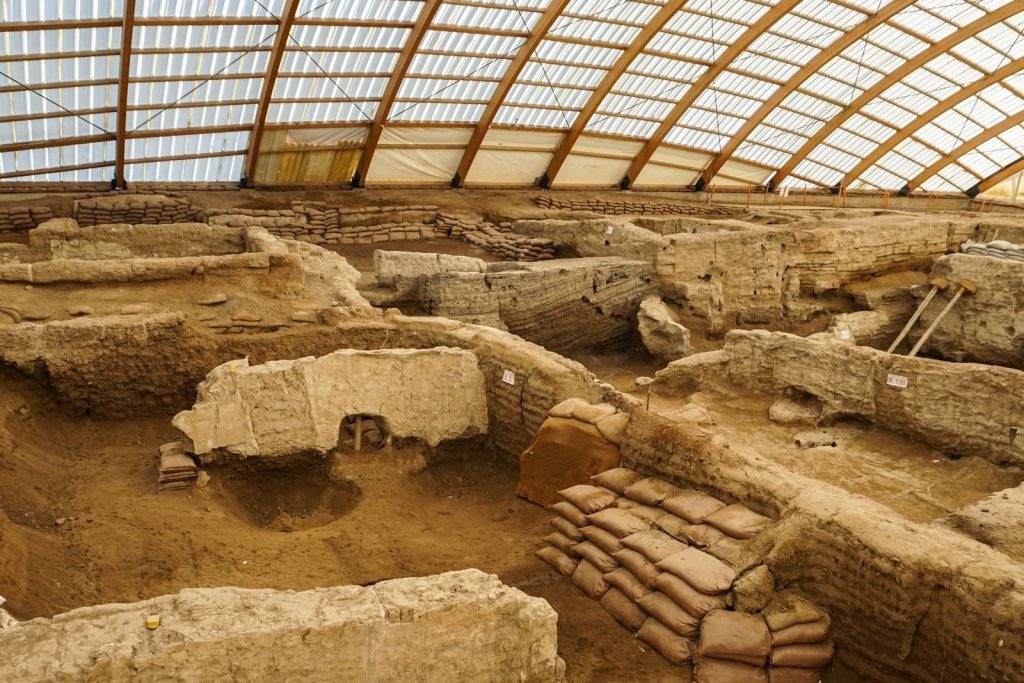
The first Yunxian skull was uncovered in 1989, followed by a second in 1990 and a third in 2022. All came from the Xuetangliangzi site beside the Han River in Hubei Province. Stone tools and animal remains were also found nearby. Because the fossils remained within their ancient sedimentary layers, researchers could study them alongside the geological evidence. However, pressure from overlying soil had flattened and distorted the skulls, complicating attempts to identify their species and evolutionary relationships.
Crushed Fossil Skull Bone Reconstruction

The Yunxian skulls retained thick brow ridges, large braincases and broad facial structures, but geological pressure had pushed their bones out of position. Early reconstructions produced different skull shapes depending on how researchers corrected that damage. Some features appeared similar to Asian Homo erectus, while others seemed closer to later human groups. This unusual mixture encouraged proposals that the fossils might represent a separate lineage. The physical distortion therefore became central to the decades-long disagreement over their identity.
3D Digital Fossil Reconstruction Computer Model

In 2025, researchers used high-resolution scans and computer modeling to reconstruct the second skull. They examined thousands of possible configurations to determine how its bones may have fitted together before burial damage. The resulting model displayed a relatively large braincase and a mixture of older and more modern features. Based on the age accepted at the time, the researchers proposed possible links with the broader group containing Homo longi and Denisovans. The much older date now complicates that interpretation.
Isochron Cosmogonic Isotope Quartz Dating

The latest study dated quartz grains from gravel surrounding the skulls. Before burial, cosmic rays produced rare forms of aluminum and beryllium inside the exposed quartz. Once sediment covered the grains, production stopped, and the isotopes began changing at predictable rates. By measuring their remaining proportions, researchers calculated how long the gravel had been buried. This method is especially useful at locations where volcanic ash or other materials commonly used for dating ancient sites are unavailable.
Prehistoric Human Fossil Timeline Chart

The analysis produced an estimated burial age of 1.77 million years, with an uncertainty of about 80,000 years. That result places the Yunxian fossils close to the earliest known human dispersals beyond Africa. Their age also makes an early Homo erectus classification more likely than interpretations connecting them directly with much later Denisovan-related populations. However, dating a sediment layer and classifying a damaged skull remain separate scientific tasks, so the fossils’ precise position in the human family tree is still debated.
Ancient Early Human Migration Route Map
The new date brings Yunxian surprisingly close in time to the early human fossils at Dmanisi in Georgia, which are approximately 1.8 million years old. The distance between the sites suggests that early humans may have spread across Eurasia much faster than older models assumed. Rather than remaining near western Asia for hundreds of thousands of years, adaptable populations could have reached eastern Asia relatively soon after leaving Africa. Stone tools from other Asian sites also support an early presence across the continent.
Archaeologists Studying Prehistoric Human Fossil

The new age does not settle every question. Scientists must independently test the burial date, refine the digital reconstructions, and compare the skulls with additional fossils. Researchers also need to determine whether all three individuals belonged to one population. The discovery demonstrates how one new technique can transform the meaning of fossils studied for decades. What once looked like an unusual million-year-old skull may instead record one of humanity’s earliest and fastest journeys across the ancient world. This article is for informational purposes only.
featured Image: Photo by Lua Morales on Pexels
Leave a Reply