NASA’s Psyche spacecraft was not built to orbit Mars, yet its May 15, 2026 gravity-assist flyby produced striking new views of the Red Planet. Approaching at a high phase angle, the probe first saw Mars as a thin crescent before recording detailed surface images while passing 2,864 miles, or 4,609 kilometers, above the planet.
The images were released with a time-lapse after weeks of downlinking and analysis. They show the south polar cap, Huygens crater, wind-streaked terrain, and Mars changing from a crescent to a nearly full disk. The encounter also let engineers test Psyche’s cameras and other instruments before the spacecraft reaches its asteroid target in 2029.
Psyche Photographed Mars as a Thin Crescent
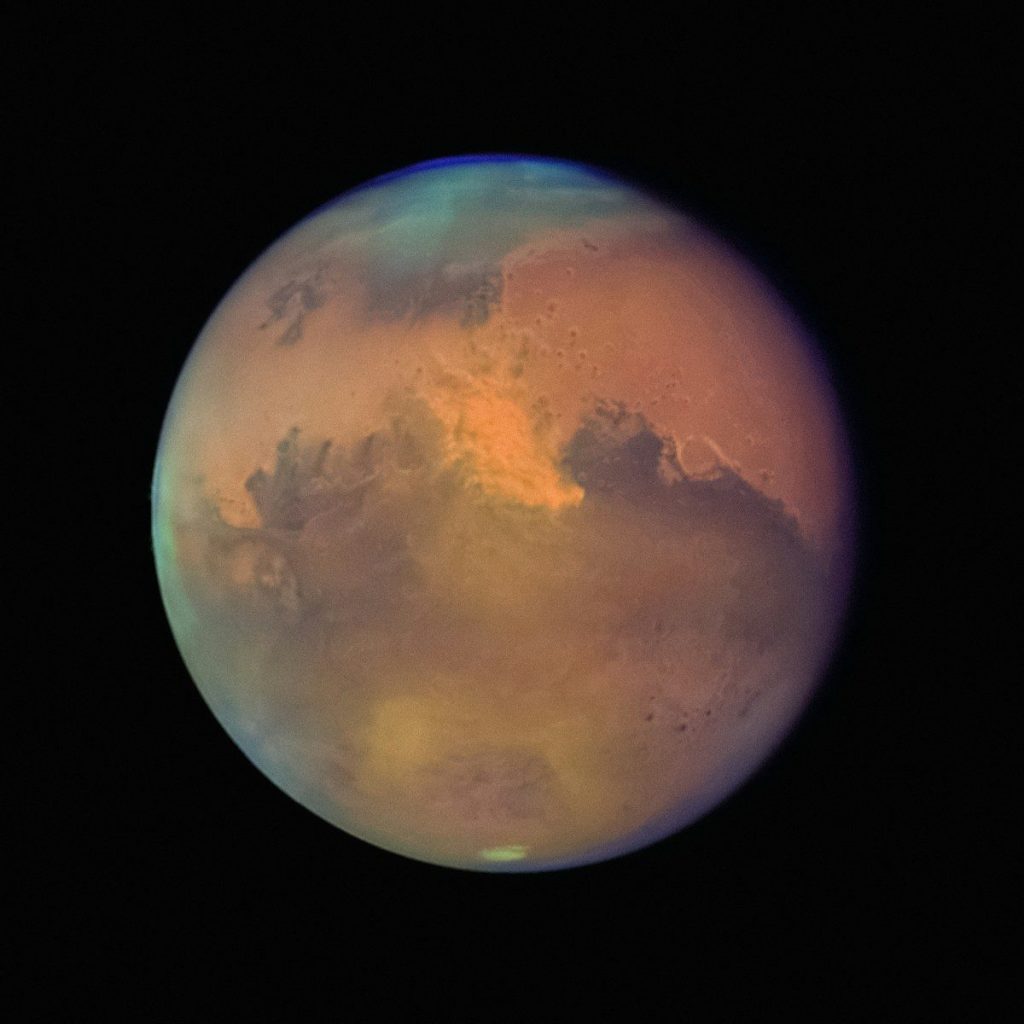
Mars usually appears in familiar sunlit forms in images from orbiters, rovers, or Earth-based telescopes. Psyche approached from a geometry in which the Sun illuminated only a narrow part of the disk from the spacecraft’s viewpoint. That high phase angle created a slender crescent, while sunlight scattered through the dusty Martian atmosphere made the bright arc extend farther around the planet than the imaging team initially expected. Such a geometry is common for inner planets seen from farther out, but unusual in close spacecraft portraits of Mars.
Mars Gravity Boosted Psyche Toward Its Asteroid Target

The Mars encounter was essential to Psyche’s route, not a sightseeing detour. By flying close to the planet, the spacecraft borrowed momentum from Mars’ gravity, gaining about 1,000 miles per hour and shifting its orbital plane by roughly one degree. That maneuver changed the trajectory without consuming the propellant that a comparable engine burn would have required, keeping the mission on course for a 2029 rendezvous. The precision mattered because even a small navigation error could have placed the spacecraft on the wrong path around the Sun.
Psyche Used Twin Multispectral Cameras During the Mars Flyby
Psyche carries a multispectral imager made from two identical cameras. The system records visible light and selected wavelengths that can help scientists distinguish surface materials. During the Mars flyby, the cameras collected thousands of images across changing distances and lighting conditions. Comparing those observations with established Mars data gives the team a practical way to calibrate sensitivity, scattered-light performance, color response, and image-processing tools before asteroid operations begin. Mars supplied familiar features and reliable reference measurements for checking whether the instrument reproduced them correctly.
Psyche Captured Mars’ South Polar Cap and Huygens Crater
Near closest approach, Psyche photographed recognizable Martian landmarks at useful detail. The sequence includes the water-ice-rich south polar cap, which is more than 430 miles across, the large double-ringed Huygens crater, and wind streaks around impact craters in the Syrtis Major region. These scenes were not intended to replace dedicated Mars mapping missions; they supplied an independent dataset from an unusual trajectory and viewing angle. NASA also assembled an enhanced-color mosaic from four images taken during the May 15 passage.
Martian Dust Brightened the Planet’s Crescent Edge
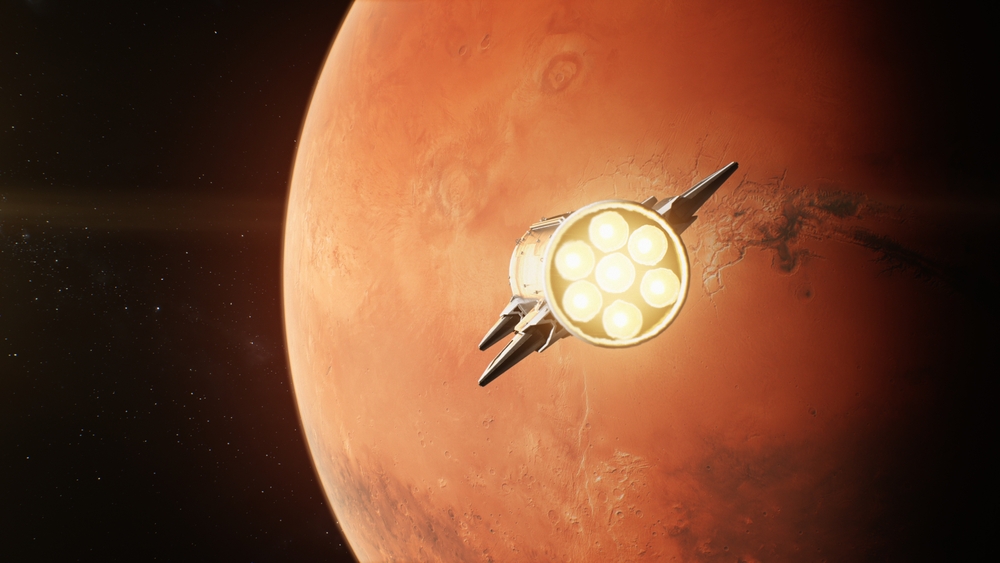
The thin crescent offered more than an attractive picture. Its unexpected brightness helped the team examine how sunlight behaves when it passes through and scatters within Mars’ dusty atmosphere. Because Psyche’s eventual asteroid target has no substantial atmosphere, Mars provided a demanding calibration case. Understanding stray and scattered light now should help researchers separate real surface features from optical effects when the spacecraft begins close-range mapping of asteroid Psyche. The exercise exposed the detector to extreme contrast between black space, the bright atmospheric limb, and the darker surface.
Psyche Measured Mars’ Magnetic Field and Neutron Activity
Other instruments also used Mars as a rehearsal target. Psyche’s magnetometer detected a strong increase in magnetic field near the planet’s bow shock, where the solar wind meets the Martian magnetic environment. The neutron spectrometer recorded the expected rise in neutron counts near closest approach, while the flyby altitude was too great for detectable Martian gamma rays. Together, the results confirmed that the instruments responded as mission planners expected. The gamma-ray result was expected rather than a failure because the spacecraft remained too far from the surface.
Psyche Photographed Phobos and Deimos as Practice Targets
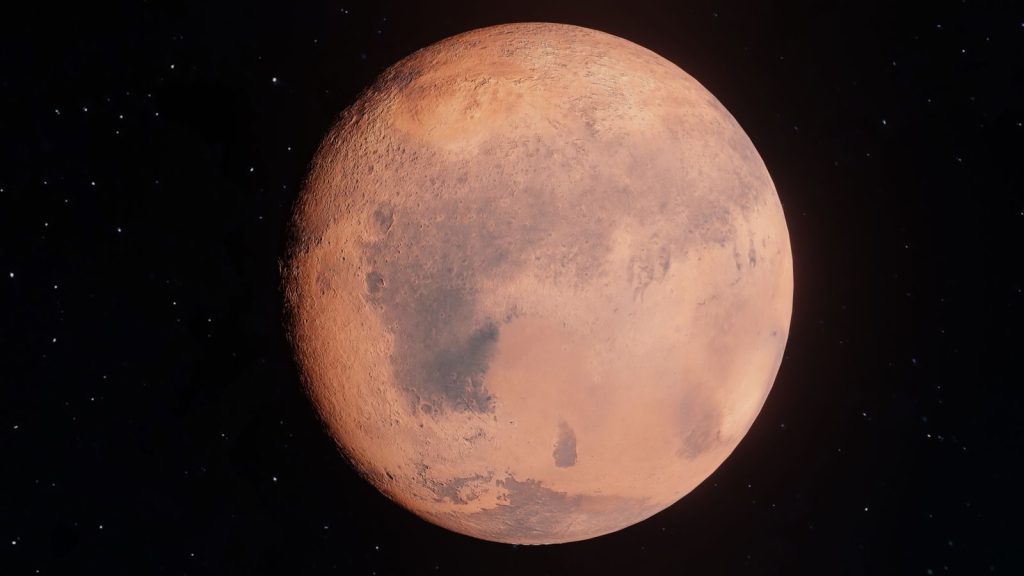
The imaging team also identified Mars’ small moons, Phobos and Deimos, from a great distance. That exercise matters because scientists plan to search for possible moonlets around asteroid Psyche. Spotting faint objects beside a much brighter body requires careful exposure control and image processing. The successful Mars observations therefore tested not only the cameras’ ability to photograph a planet, but also techniques that may reveal previously unknown companions at the mission’s destination. Psyche captured them during a deliberate practice search, not as a new discovery of either moon.
Psyche Continues Toward Its Metal-Rich Asteroid Target

After the flyby, Psyche continued toward the main asteroid belt and is scheduled to reach asteroid Psyche in summer 2029. The roughly 173-mile-wide object may contain large amounts of metal and could preserve clues about the building blocks of rocky planets. The Mars images are therefore both a scientific bonus and a milestone: they show that the spacecraft can navigate a planetary encounter and return calibrated data before its primary investigation begins. It will then enter orbit and map the body through a planned sequence of changing altitudes.
Featured Image: Photo by Javier Miranda on Unsplash
Leave a Reply