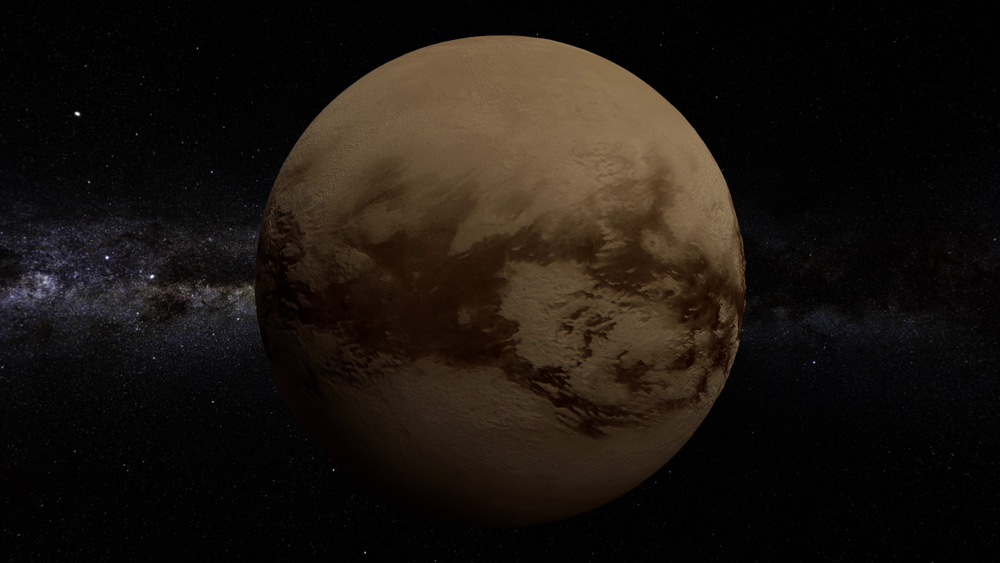
The James Webb Space Telescope captured its first images of Titan on November 4, 2022, not immediately before this article. Scientists have also studied Saturn’s largest moon for decades using ground-based observatories and spacecraft including Voyager and Cassini.
What was new was Webb’s infrared view. Its instruments could examine Titan’s clouds, lower atmosphere and portions of its surface through wavelengths that are partly blocked from observatories on Earth.
Titan has an Earth-like weather cycle made from methane

Titan is the only moon known to possess a dense atmosphere. It also has rivers, lakes and seas on its surface, but their liquid is primarily methane and ethane rather than water. Methane evaporates, forms clouds and can fall as rain, creating a weather cycle that resembles Earth’s water cycle in structure while operating at temperatures cold enough for water ice to behave like solid rock.
Two bright clouds appeared in Webb’s first images
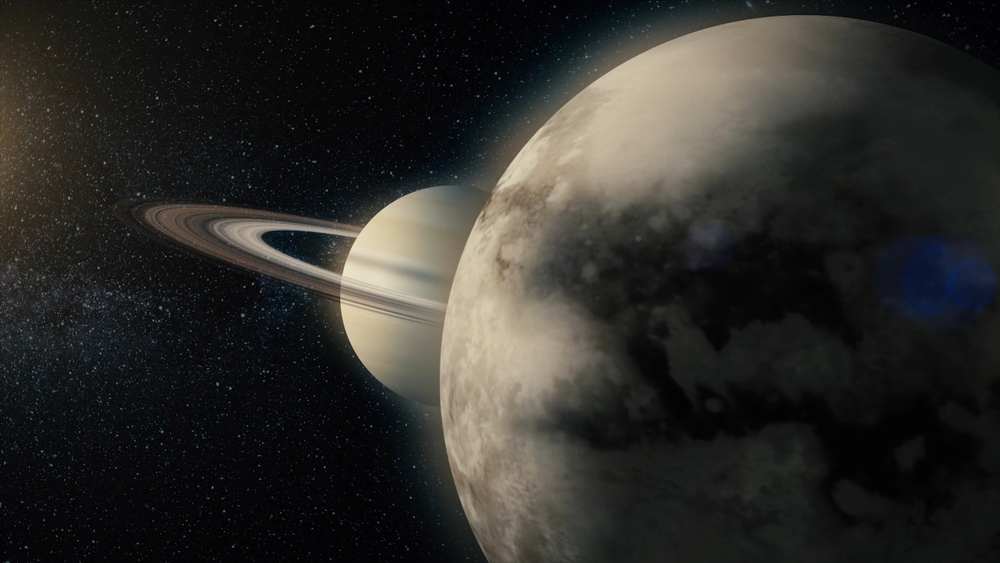
Webb’s Near-Infrared Camera detected two prominent bright areas in Titan’s northern hemisphere. Researchers identified them as clouds rather than surface features. One appeared near the northern polar region, close to Kraken Mare, a large methane sea. The observations supported climate models predicting cloud formation in Titan’s northern mid-latitudes during late summer, when solar heating encourages methane to evaporate from the surface.
Keck observed the moon two days later

Scientists quickly requested follow-up observations from the W.M. Keck Observatory in Hawaii. Keck imaged Titan approximately 30 hours after Webb and found clouds in similar locations, although their shapes had changed. Researchers could not confirm that they were exactly the same clouds because clouds can form and disappear quickly. Combining the two observatories nevertheless allowed the team to investigate changing weather and air movement over several days.
Later observations revealed northern cloud convection

Webb and Keck observed Titan again in July 2023. Images taken three days apart showed methane clouds appearing at different altitudes, indicating upward movement through the atmosphere. NASA described this as the first evidence of cloud convection in Titan’s northern hemisphere. The finding matters because most of Titan’s lakes and seas are concentrated in the north, where evaporation may supply methane to developing clouds.
Webb detected a missing step in Titan’s chemistry

Webb made the first definitive detection on Titan of the methyl radical, written as CH₃. This highly reactive molecule forms when sunlight or energetic particles break methane apart. It can then combine with other material to help form ethane and increasingly complex carbon-bearing molecules. Scientists had previously observed methane and many of its final chemical products, but detecting CH₃ allowed them to observe an important intermediate stage of the process.
Titan may eventually lose its atmospheric methane
When methane breaks apart, some of its hydrogen can escape into space while heavier carbon-containing products settle toward Titan’s surface. Unless methane is being replenished from the moon’s crust or interior, its atmospheric supply will gradually decline. Researchers do not yet know whether Titan has maintained its methane through continuous geological releases or whether the atmosphere is passing through a limited phase in the moon’s history.
Titan’s Organic Chemistry Is Not Evidence of Life

Titan is important to astrobiology because it contains complex organic chemistry and environments unlike any on Earth. Organic molecules are necessary for known life, but their presence does not demonstrate that organisms exist. Webb’s observations revealed methane weather, cloud movement and active chemical reactions, not a biosignature. Their value lies in showing how a cold world can maintain an atmosphere, surface liquids and complicated carbon chemistry without behaving exactly like Earth.
Featured Image: Shutterstock
Leave a Reply