
The Milky Way did not form as a finished spiral floating peacefully in space. It grew through repeated encounters with smaller galaxies, absorbing their stars, gas, dark matter, and star clusters.
One of its most important mergers involved a dwarf galaxy now called Gaia–Enceladus. The merger happened approximately 10 billion years ago, not thousands of years ago, and its stellar remains are still moving through the Milky Way today.
Gaia turned stellar motion into history

Astronomers uncovered the merger by studying observations from the European Space Agency’s Gaia mission. Gaia measured the positions and movements of enormous numbers of stars with unprecedented precision.
When researchers traced certain stars through space, they found a population following unusual, stretched, and sometimes slightly retrograde orbits. Those shared movements suggested that the stars had once belonged to another galaxy.
The lost galaxy gained two unusual names

Researchers call the vanished galaxy Gaia–Enceladus, after ESA’s Gaia spacecraft and the mythological giant Enceladus.
It is also known as the Gaia Sausage because its stars form an elongated, sausage-shaped structure when their velocities are plotted. The name may sound humorous, but the pattern revealed a distinct population of stars that could not be explained by the Milky Way’s normally rotating disk.
This was more than a minor collision
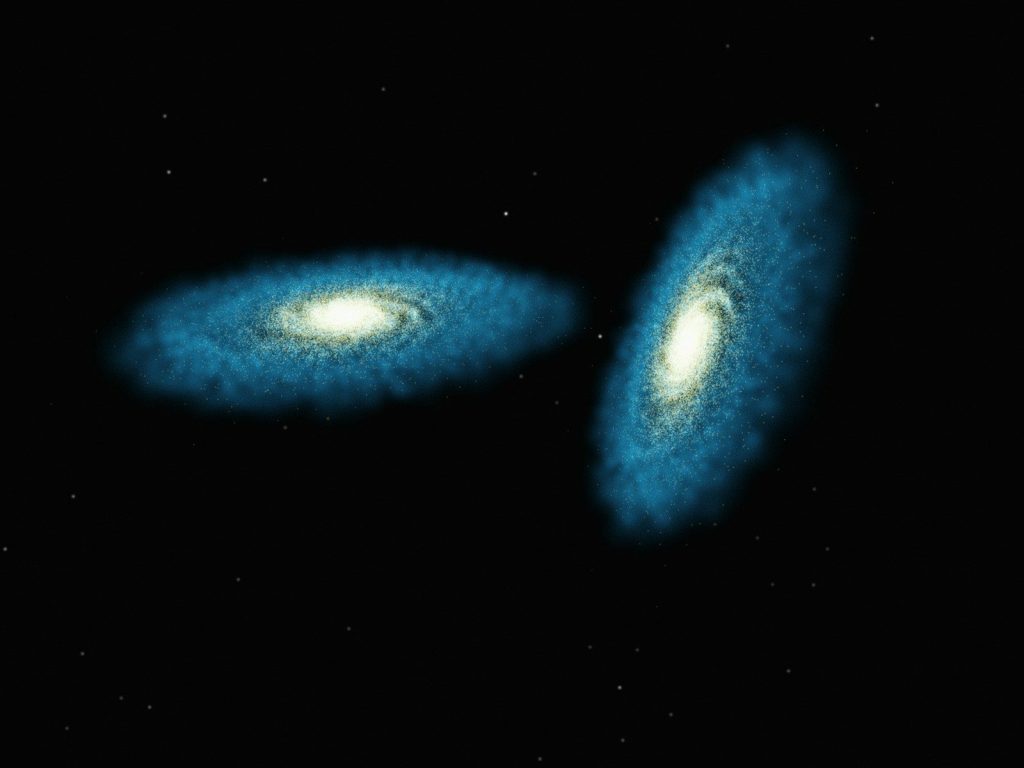
Gaia–Enceladus was probably comparable in size to one of the Magellanic Clouds. The early Milky Way was also much smaller than it is today, so researchers estimate that the galaxies’ mass ratio may have been approximately four to one.
That made the encounter a major merger capable of altering the young Milky Way’s structure rather than a small satellite being quietly absorbed.
Its stars are scattered across the sky
The original galaxy no longer exists as a recognizable object, but its debris is extensive. Candidate Gaia–Enceladus stars cover nearly the entire sky and now form a major component of the Milky Way’s inner stellar halo.
ESA researchers have also connected hundreds of variable stars and at least 13 globular clusters to similar trajectories, suggesting that the absorbed galaxy once possessed its own large family of star clusters.
Chemistry reveals where the stars formed

Motion is only part of the evidence. Astronomers also examine the ages and chemical compositions of stars, treating their elemental abundances like historical fingerprints.
Stars formed inside different galaxies experience different patterns of star formation and chemical enrichment. The combination of unusual chemistry, ancient ages, and distinctive orbits helped researchers separate Gaia–Enceladus debris from stars born inside the early Milky Way.
The impact helped reshape the Milky Way

The collision probably heated and disturbed an early stellar disk, pushing some of its stars into wider and more inclined orbits.
Researchers concluded that the event contributed to the formation of the Milky Way’s thick disk, an older, vertically extended population surrounding the thinner disk where most recent star formation occurs. The galaxy that disappeared therefore helped shape a major structure that remains visible today.
The Milky Way is a galactic fossil record

The phrase “swallowed a galaxy” is a metaphor for a long gravitational merger, not a single violent event. Over time, Gaia–Enceladus was torn apart and mixed into the Milky Way.
Its stars remain identifiable because their movements, chemistry, and ages preserve evidence of their shared origin. By reading those clues, astronomers can reconstruct events that occurred billions of years before Earth existed.
Featured Image: Photo by Javier Miranda on Unsplash
Leave a Reply