Category: Science & Biology

  • 10 strange things humans are still learning about the seafloor

    10 strange things humans are still learning about the seafloor

    The seafloor may be Earth’s biggest mystery hiding in plain sight. It covers huge parts of the planet, yet much of it remains unseen by human eyes. NOAA Ocean Exploration says less than 0.001% of the deep ocean seafloor has been directly observed, which means scientists are still working with a very small window into an enormous world.

    What they have found is anything but boring. The seafloor holds underwater mountains, canyons, hot vents, cold seeps, strange animals, hidden minerals, and ecosystems that do not need sunlight. New mapping tools, deep-diving robots, and DNA studies are helping researchers uncover details that were once out of reach. Each discovery reminds us that the ocean floor is not just a dark, flat bottom. It is a living, changing landscape full of surprises.

    Most of it remains unseen

    Explore the vibrant underwater world of tropical coral reefs in this clear ocean shot.
    Photo by Francesco Ungaro on Pexels
    The seafloor is often shown as a smooth blue space on maps, but that picture hides how little we have actually seen. Many deep areas are still unexplored, especially far from coastlines.

    NOAA says explorers have directly observed less than 0.001% of the deep ocean seafloor. That is why new dives can still reveal animals, landscapes, and features that scientists have never documented before.

    Underwater mountains are everywhere

    A person scubas in the water near a rock formation
    Photo by Artists Eyes on Unsplash

    Seamounts are underwater mountains that rise from the seafloor. Many are old volcanoes, and they can create rich habitats where currents bring food and animals gather.

    NOAA says data suggests there may be more than 100,000 seamounts at least 1,000 meters high. Yet less than one-tenth of one percent have been explored, leaving thousands of hidden peaks still waiting for study.

    Vents power life without sun

    a bird flying over a body of water
    Photo by Bernd 📷 Dittrich on Unsplash

    Hydrothermal vents form when hot, mineral-rich water rises from cracks in the seafloor. They can look harsh, but they support some of the strangest communities on Earth.

    Instead of relying on sunlight, many vent ecosystems depend on microbes that use chemicals for energy. NOAA explains that vents are hot springs created by underwater volcanoes or tectonic activity, with life adapted to deep darkness.

    Cold seeps are busy too

    expn0686” by NOAA Photo Library is licensed under CC BY 2.0

    Not every strange seafloor habitat is hot. Cold seeps release fluids such as methane-rich water from the seabed, creating chemical-rich places where unusual life can grow.

    These habitats can support clams, mussels, worms, and microbes that use chemical energy. They show that the seafloor has many ways to feed life, even where sunlight never reaches.

    Canyons cut deep paths

    Underwater cave with light shining through.
    Photo by Erick Morales Oyola on Unsplash

    Underwater canyons can slice through the seafloor like giant valleys. Some begin near continental shelves and stretch far into the deep ocean.

    These canyons can move sediment, nutrients, and organic material from shallow areas into deeper water. They may also create habitats for corals, sponges, fish, and other animals that depend on changing currents and food flow.

    Deep corals grow in darkness

    gray fish
    Photo by Jakub Dziubak on Unsplash

    Corals are often linked with warm, sunny reefs, but some corals live in cold, dark water far below the surface. These deep-sea corals do not need sunlight the way tropical reef corals do.

    NOAA lists deep-sea corals and sponges among the important habitats found in the deep ocean. They can provide shelter for many animals, even in places that look empty at first glance.

    New species keep appearing

    jellyfish, sea, nature, water, stinging, marine, species
    Photo by Tyna_Janoch on Pixabay

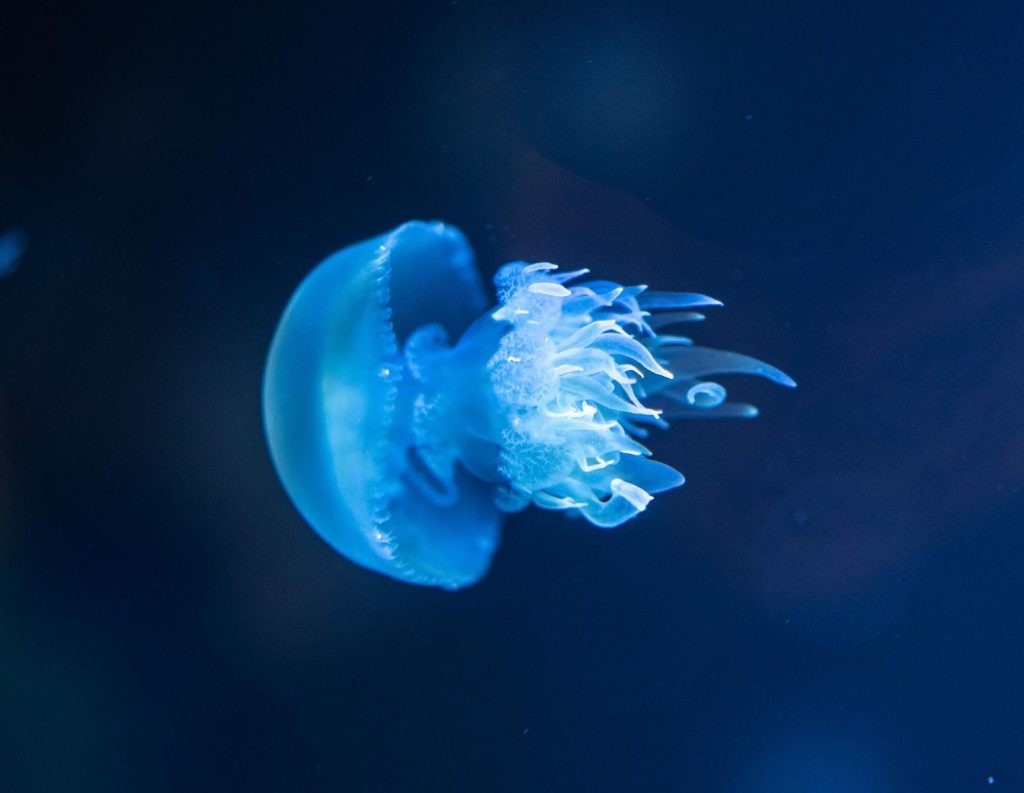
    The seafloor is still giving scientists new animals to study. Deep-sea expeditions often collect samples or footage that later reveal species no one had officially described before.

    Ocean Census reported in 2025 that more than 800 new marine species had been discovered through its work. That kind of progress shows how much life may still be undocumented beneath the waves.

    Robots are changing exploration

    a robot that is standing in the water
    Photo by Cash Macanaya on Unsplash

    Exploring the seafloor is difficult because deep water brings darkness, pressure, distance, and cold. Humans cannot simply walk around down there with a notebook.

    That is why remotely operated vehicles, autonomous vehicles, cameras, sonar, and sampling tools are so important. NOAA says ocean exploration helps characterize unknown areas, and its 2025 work included mapping 339,864 square kilometers of seafloor.

    The seafloor is always moving

    Tranquil underwater scene showcasing ocean sand and sunlight filtering through clear blue water.
    Photo by David Boca on Pexels
    The ocean floor may seem still, but it is part of a restless planet. Plates shift, volcanoes erupt, vents open and close, and sediments slide over time.

    These changes can reshape habitats and create new ones. A seafloor area that looks quiet today may have been shaped by earthquakes, lava, currents, or ancient landslides long before researchers arrived.

    It may guide space science

    space shuttle view outside the Earth
    Photo by NASA on Unsplash

    The seafloor helps scientists think about life beyond Earth. Places like vents and seeps show that life can survive without sunlight when water, chemistry, and energy come together.

    That matters for the search for life on ocean worlds, such as icy moons with hidden seas. Earth’s deep seafloor gives researchers a real place to study how life might exist in dark, extreme environments.

  • What tiny deep-sea animals can teach us about survival
    What tiny deep-sea animals can teach us about survival

    The deep ocean looks like one of the toughest places on Earth to make a living. It is dark, cold, under heavy pressure, and often short on food. Yet tiny animals still manage to survive there, from small crustaceans and worms to delicate drifting creatures that glow, hide, hunt, or wait for scraps falling from above.

    Their lives show that survival is not always about being big or fast. Sometimes it is about saving energy, using the right signal, blending in, moving slowly, or building life around small chances. NOAA notes that below 200 meters, sunlight fades away, and food becomes harder to find, shaping how deep-sea animals live.

    Small bodies can be powerful

    Copepod with eggs” by kat m research is licensed under CC BY-SA 2.0

    Tiny deep-sea animals may seem fragile, but size can be an advantage. Small bodies need less food, which matters in places where meals may be rare and spread far apart.

    Instead of wasting energy, many deep-sea creatures live carefully. They move only when needed, grow slowly, and use every bit of food they can find. In a world with limited resources, being small can be a smart survival plan.

    Darkness changes every rule

    body of water during daytime
    Photo by Conor Sexton on Unsplash

    In the deep sea, sunlight does not guide daily life. NOAA explains that below 200 meters, animals cannot depend on normal vision the way many surface animals do.

    That forces tiny animals to survive in other ways. Some sense movement, chemicals, touch, or faint light made by other creatures. Their world reminds us that when one sense becomes less useful, life can find another path.

    Glowing can send messages

    body of water during night time
    Photo by Trevor McKinnon on Unsplash

    Bioluminescence is one of the deep sea’s most famous tricks. MBARI says about three-quarters of life in the water column can produce light, making glow a common language in the deep ocean.

    Tiny animals may use light to confuse predators, attract prey, or find each other in the dark. In a place with almost no sunlight, making your own light can be a lifeline.

    Hiding can mean surviving

    brown turtle on water
    Photo by NOAA on Unsplash

    Not every deep-sea animal wants to glow. Some tiny creatures survive by becoming hard to see. Monterey Bay Aquarium notes that many deep-sea animals are transparent, while others use red coloring as camouflage in dark water.

    These tricks help small animals avoid attention. When predators are nearby and escape space is limited, blending into the background can be just as important as speed.

    Food falls from above

    brown and white plant in close up photography
    Photo by David Clode on Unsplash

    Much deep-sea life depends on tiny bits of food drifting down from the upper ocean. Smithsonian Ocean explains that food is often scarce in the abyss, where only small amounts reach the seafloor.

    Tiny animals must be ready when food arrives. Some wait, some scavenge, and some feed on particles too small for larger animals to use well. Survival often means wasting nothing.

    Pressure rewards smart design

    school of fish in body of water
    Photo by Francesco Ungaro on Unsplash

    Deep-sea pressure would be dangerous for humans, but many small ocean animals are built for it. Woods Hole Oceanographic Institution explains that deep-ocean animals often do not have air-filled spaces like lungs, which helps them handle pressure.

    That teaches a simple lesson: survival depends on matching your body to your world. Deep-sea animals do not fight pressure the way humans would. They are shaped for it.

    Slow life still works

    photography of sea corals
    Photo by Scott Webb on Unsplash

    Life in the deep sea often moves at a slower pace. When food is limited and temperatures are cold, rushing can waste energy that animals cannot easily replace.

    Tiny deep-sea animals show that slow does not mean weak. A careful life can be a winning strategy when the environment is harsh. Saving energy, waiting well, and choosing the right moment can keep small creatures alive.

    Crowds follow rare meals

    blue and gray fish near corrals
    Photo by Shaun Low on Unsplash

    When a big food source reaches the deep seafloor, animal communities can change quickly. MBARI reported that sea pig populations may rise after large pulses of food sink into deep water.

    Tiny and small animals help show how deep-sea life responds to sudden chances. A rare meal can support many creatures, even in places that seemed nearly empty before.

    New species keep appearing

    octopus, glow, bioluminescence, underwater, creature, nature, sea, tentacles, octopus, octopus, octopus, octopus, octopus, tentacles
    Photo by Edgar117 on Pixabay

    Scientists are still finding deep-sea animals that were unknown before. A newly described small predator from the Atacama Trench, Dulcibella camanchaca, was found at great depth and shows how much remains hidden.

    Discoveries like this remind us that survival takes many forms. Even small animals in remote trenches can have special tools for hunting, hiding, and living in extreme conditions.

    Survival is about adapting

    school of fish in body of water
    Photo by Hiroko Yoshii on Unsplash

    Tiny deep-sea animals teach one big lesson: life does not need perfect conditions. It needs the right adaptations. Darkness, pressure, cold, and low food do not end the story.

    Instead, these animals glow, hide, wait, sense, conserve energy, and make use of tiny opportunities. Their world is strange, but their message is simple. Survival often belongs to those that adjust best.

  • Why you’ll never see a bluebird in the wild – it’s actually an optical illusion.

    Why you’ll never see a bluebird in the wild – it’s actually an optical illusion.

    Blue is the rarest color in nature. While you might see a bright blue jay or a mountain bluebird in your backyard, you are actually looking at a scientific lie. Unlike red, yellow, or brown, which come from pigments in the feathers, there is no such thing as “blue pigment” in birds. If you were to take a blue feather and grind it into powder, the powder would be a dull, dark gray. The blue you see is a masterpiece of physics known as “structural color.”

    This discovery is hitting the news as a major win for biomimicry. Scientists are studying bird feathers to create “paint that never fades” and screens that use zero energy. We are looking at a world where the most beautiful things we see are actually tricks of the light. It turns out that the bluebird is essentially a living prism. But how does a piece of protein actually “create” a color out of thin air? Wait until you see the microscopic structures hiding in the wings.

    The Secret of the Tyndall Effect

    macroperspective, feather, down, dew, blue light, dewdrop, waterdrop, lichtspiel, blue, macro, close up, feather, feather, feather, blue, blue, blue, blue, blue
    Photo by 165106 on Pixabay

    Bird feathers are made of keratin—the same stuff as your fingernails. In “blue” birds, the keratin is full of millions of tiny air pockets. When sunlight hits these pockets, the shorter wavelengths of light (blue) are scattered in every direction, while the longer wavelengths (red and yellow) are absorbed by a layer of dark melanin underneath. This is called the Tyndall effect. It is the same reason the sky looks blue. The bird is literally wearing a piece of the sky. But wait until you see what happens when the sun goes down.

    The Disappearing Act at Sunset

    A beautiful bluebird perches on a branch.
    Photo by anish lakkapragada on Unsplash

    Because the blue color depends entirely on how light scatters, a bluebird can “change” color depending on the angle of the sun. In the shade or during a cloudy day, the bird might look gray or even black. This “shimmering” effect is why bluebirds often seem to appear and disappear in the forest. They are masters of a “light-based” camouflage that forward-thinking hunters are now trying to copy. But why doesn’t this happen to red birds?

    Why Red Birds are the “Real” Deal

    selective focus photography of red cardinal on tree
    Photo by Timothy Dykes on Unsplash

    Red birds, like the Northern Cardinal, get their color from “carotenoids”—chemicals found in the berries and seeds they eat. If you grind up a red feather, it stays red. This is a “chemical color” that is stable and consistent. Red birds are effectively “dying” their feathers from the inside out. Blue birds, however, have to maintain the perfect “shape” of their feathers to stay blue. If the feathers get dirty or wet, the illusion breaks. But this “structural” secret is also found in your own eyes.

    The Mystery of the Blue Human Eye

    blue eye photo
    Photo by Ion Fet on Unsplash

    Just like the bluebird, there is no blue pigment in human eyes. Everyone on Earth technically has brown eyes, but some people have “structural color” in their iris. The blue in a person’s eye comes from light scattering through the clear stroma layer. If you have blue eyes, you are literally looking through a trick of the light every time you check the mirror. This biological similarity is helping doctors understand how light affects our vision. But wait until you see the “Blue Butterfly” problem.

    The Most Vibrant Lie in the Jungle

    A vibrant blue butterfly rests on a textured rock.
    Photo by Magic Fan on Unsplash

    The Blue Morpho butterfly is the king of structural color. Its wings are so bright they can be seen from low-flying planes. This is because the “scales” on its wings are shaped like tiny Christmas trees that bounce light back with incredible efficiency. Scientists are now trying to “grow” these structures in labs to create the next generation of digital displays. We are copying a butterfly’s “lie” to make our phones look better. But can this tech actually help save the planet?

    Cool Buildings and the Blue Shield

    A building with a curved roof against a blue sky
    Photo by Declan Sun on Unsplash

    Because structural color scatters light instead of absorbing it, things that are “structurally blue” stay much cooler in the sun. Engineers are designing “structural blue” paints for roofs and cars that can lower internal temperatures by 10 degrees without using any power. It is a total revolution for sustainable building. We are using the bluebird’s secret to fight global warming. But wait until you see the “lost” continent that was just found under the ice.

    Why We Need to Protect the Illusion

    triangular red and blue triangle illustration
    Photo by Michael Dziedzic on Unsplash

    As the environment changes, birds are struggling to keep their “structural” secrets. Pollution and habitat loss affect the health of their feathers, which can dull their color and make it harder for them to find mates. Protecting the bluebird means protecting the physics of our world. We are in a race to preserve the most beautiful “optical illusions” on Earth before they fade away forever. But while we look at the feathers, a new world is being mapped under the South Pole.

    The Future is Structurally Blue

    blue and brown bird on brown wooden fence
    Photo by Joshua J. Cotten on Unsplash

    The bluebird teaches us that what we see isn’t always what is there. It is a reminder to keep looking closer, even at the things that seem simple. The science of light is opening new doors for our technology and our understanding of life. We are finally learning to see the world for what it truly is—a masterpiece of design. But are you ready for the “frozen” secret hiding at the bottom of the world?

    Featured Image: Photo by Naturelady on Pixabay